Just to make it clear that I'm not spending all of my time drinking and looking at lolcats, I would like to add that breaking up tends to be a great impetus for self improvement. At least, that's been my experience.
It is good to get jolted out of complacency, break routines and cycles, and live in such a way as to to cognizant of even trivial things. Being present and living in an examined fashion is necessary for any success or happiness to proceed. At least for me- I am not happy with stagnation. As unfun as, say, ending a relationship is, I really do believe that if nothing bad ever happened to us we would not be very effective humans. Adaptation and learning need necessity.
As such, I've been animated with this feeling of ambition and confidence in the last twenty four hours that seems silly on the face of it. I've been feeling more social, more able to work, and even better able to sit down and pay attention to things. I have had extended conversations with strangers, and felt perfectly alright about it. This is curious. One would think that being spurned by a lover would have the opposite effect.
In any case, I'm happy to respond to undesirable instances with something like a plan, or attitude of ambition. This is not to say that I'm happy about recent events- I'm not- but it is very possible to derive positive outcomes from things like this.
In other words, life is not completely in the Sad Panda realm. The Sad Panda is making himself very, very busy.
Saturday, April 10, 2010

Friday, April 9, 2010
A Ritual
There is a ritual to it.
Last night at I was over at some friends' house, drinking a rather delicious vodka cocktail that was going to my head. We talked about, refreshingly, trivial things. Books mostly. I had some leftover pizza, and went home where I couldn't sleep. I opened a bottle of wine and began clicking away at intellectually undemanding websites, watching humorous videos and looking at amusingly captioned pictures of cats and other animals. For some reason, I started listening to Prince, an artist whom I've always admired more than i enjoyed. It seemed like a good idea at the time, though.
Eventually, after consuming the entirety of a bottle of wine, after I couldn't stay awake any longer, I went to sleep. I'd made my bed and cleaned my room because she was coming over, and seeing that tidiness just before sleep was somewhat painful. I went to sleep, woke up, and slept again. I woke up and read for some time, despite being tired.
In a certain way, I've been very lucky. I've had some wonderful relationships, and none of them have ended particularly badly. I have only, once, yelled at a girlfriend. I have never had a relationship end with a fight or any any kind of acrimony. My relationships have ended as well as anyone can hope for, with a minimum of drama, and a certain degree of amicability. For that, I think I'm truly fortunate.
Nevertheless, there is a certain amount of ritual wallowing that goes on. Even as I'm sitting here, somewhat unkempt and watching episodes of Lost on Hulu, I'm conscious of the fact that I'm indulging in a pattern. Sad music, alcohol, consoling words from friends. I know it's a ritual, a thing that plays out again and again. What I think is fascinating is that it remains meaningful.
The exasperation of the post-breakup, the behavior and the indulgences, the conversations are all iterated again and again. There is always comfort and mucking about in negativity, always a little bit of a wallow. Nevertheless, despite the predictable nature of it, it remains necessary. How fascinating, I think, that I need to do what I know is predictable. I need to seek comfort from predictable places.
Ritual is not necessarily empty, and not necessarily codified. My hood is over my head, and I'm bent over my computer, and not planning on going anywhere anytime soon. Any fiction writer could have written my actions, and anyone astute in the ways of behavior could have predicted them. Nonetheless, in my subjective perspective, this time of post-breakup wallowing, this ritual retains its importance.
Last night at I was over at some friends' house, drinking a rather delicious vodka cocktail that was going to my head. We talked about, refreshingly, trivial things. Books mostly. I had some leftover pizza, and went home where I couldn't sleep. I opened a bottle of wine and began clicking away at intellectually undemanding websites, watching humorous videos and looking at amusingly captioned pictures of cats and other animals. For some reason, I started listening to Prince, an artist whom I've always admired more than i enjoyed. It seemed like a good idea at the time, though.
Eventually, after consuming the entirety of a bottle of wine, after I couldn't stay awake any longer, I went to sleep. I'd made my bed and cleaned my room because she was coming over, and seeing that tidiness just before sleep was somewhat painful. I went to sleep, woke up, and slept again. I woke up and read for some time, despite being tired.
In a certain way, I've been very lucky. I've had some wonderful relationships, and none of them have ended particularly badly. I have only, once, yelled at a girlfriend. I have never had a relationship end with a fight or any any kind of acrimony. My relationships have ended as well as anyone can hope for, with a minimum of drama, and a certain degree of amicability. For that, I think I'm truly fortunate.
Nevertheless, there is a certain amount of ritual wallowing that goes on. Even as I'm sitting here, somewhat unkempt and watching episodes of Lost on Hulu, I'm conscious of the fact that I'm indulging in a pattern. Sad music, alcohol, consoling words from friends. I know it's a ritual, a thing that plays out again and again. What I think is fascinating is that it remains meaningful.
The exasperation of the post-breakup, the behavior and the indulgences, the conversations are all iterated again and again. There is always comfort and mucking about in negativity, always a little bit of a wallow. Nevertheless, despite the predictable nature of it, it remains necessary. How fascinating, I think, that I need to do what I know is predictable. I need to seek comfort from predictable places.
Ritual is not necessarily empty, and not necessarily codified. My hood is over my head, and I'm bent over my computer, and not planning on going anywhere anytime soon. Any fiction writer could have written my actions, and anyone astute in the ways of behavior could have predicted them. Nonetheless, in my subjective perspective, this time of post-breakup wallowing, this ritual retains its importance.
Wednesday, March 24, 2010
Ten Hours
"If you have any guns they have to go in the trunk."
"I... I don't have any guns."
"That's fine if you do, they just will have to go in the trunk. I'm a firm believer in gun control! Keep both hands on the gun when you're firin' it! Ha!"
And thus began my ten-plus hours in a car with what can only be described as an ultra right-wing hippie. I'd gone to Craigslist to get a rideshare to San Francisco. I had several possible leads, but the only one that left when I wanted to (and wasn't going in a completely decrepit car) was one that I felt sort of sketchy about. The guy's reply had contained spelling errors, on the phone he'd seemed sort of out of it, and he said that he could take me to a BART station, but not into SF proper.
I had a bad feeling about this rideshare. A bad feeling that turned out to be entirely justified.
The guy's bead obscured most of his face and chest, and his hair was in a white tangle on top of his head. I tried to keep the conversation focused on niceties like travel and music, but every so often things like this came up:
"I'm more Republican than most Republicans."
"I say, you get six months on welfare. Six months! If you don't have your shit together after that, you should put a bullet in your head!|
"This fuckin' health care bill is government-run extortion! Just a big present for the insurance companies! Before we had insurance, everyone could affor health care!"
"That government bailout was bullshit. Fuck 'em."
"There are people living off welfare. Did you know that? They're reachin' into my pocket to live. Fuck 'em."
"I'm in favor of local currencies." Me: "What do you think about the gold standard?" "I'm all for that shit!"
"I used to be in a gang. I hurt a lot of people."
"If you can't take care of your own shit, then fuck you!"
"This world would be great if there weren't so many fuckin' idiots in it!"
"We haven't been a real democracy for over fifty years."
(I would like to emphasize that I try to use exclamation points sparingly. However, given this man's volume, passion, etc. necessitates liberal use of them.)
Ten hours of this. Ten hours. I managed to sleep for a while, and we did have some pleasant conversations, but for the most part this guy seemed to be driven entirely by anger. When he was talking about things he enjoyed, like music, hiking, or drug experiences, he lit up, and went on about how wonderful it was. However, it only took a slow car, the presence of the highway patrol, or any other aggravation to get him going on about "fuckin' idiots" once again.
It was not his conservatism that bothered me. (Conservatism weirdly blended with hippie philosophy, I might add.) I can deal with people less liberal than myself. What bothered me was that his most animating feeling was rage, the thing that fueled his conversation about politics, society, life, etc., was disdain for others, frustration at something that he saw as wholly malevolent, a lack of joy when it came to percieving others.
I sympathize with political anger. I really do. All too often, though, we forget that the vast majority of the things that we do, we do right. We are not living in an unfixable, unchangable world, nor are we in the First World under the heel of something implacable. Rage has it's place, but if it defines us, we lose. We get sour and feel impotent, and rather than a wonderfully complex world pointing in all directions, we see slings and arrows coming directly for us.
I got out, after ten hours, and made my way quickly into the BART station. I cracked open the Neal Stephenson book I'm reading, and sunk into the intellectual joy of the fiction. I rode the train for the better part of an hour, and relaxed.
"I... I don't have any guns."
"That's fine if you do, they just will have to go in the trunk. I'm a firm believer in gun control! Keep both hands on the gun when you're firin' it! Ha!"
And thus began my ten-plus hours in a car with what can only be described as an ultra right-wing hippie. I'd gone to Craigslist to get a rideshare to San Francisco. I had several possible leads, but the only one that left when I wanted to (and wasn't going in a completely decrepit car) was one that I felt sort of sketchy about. The guy's reply had contained spelling errors, on the phone he'd seemed sort of out of it, and he said that he could take me to a BART station, but not into SF proper.
I had a bad feeling about this rideshare. A bad feeling that turned out to be entirely justified.
The guy's bead obscured most of his face and chest, and his hair was in a white tangle on top of his head. I tried to keep the conversation focused on niceties like travel and music, but every so often things like this came up:
"I'm more Republican than most Republicans."
"I say, you get six months on welfare. Six months! If you don't have your shit together after that, you should put a bullet in your head!|
"This fuckin' health care bill is government-run extortion! Just a big present for the insurance companies! Before we had insurance, everyone could affor health care!"
"That government bailout was bullshit. Fuck 'em."
"There are people living off welfare. Did you know that? They're reachin' into my pocket to live. Fuck 'em."
"I'm in favor of local currencies." Me: "What do you think about the gold standard?" "I'm all for that shit!"
"I used to be in a gang. I hurt a lot of people."
"If you can't take care of your own shit, then fuck you!"
"This world would be great if there weren't so many fuckin' idiots in it!"
"We haven't been a real democracy for over fifty years."
(I would like to emphasize that I try to use exclamation points sparingly. However, given this man's volume, passion, etc. necessitates liberal use of them.)
Ten hours of this. Ten hours. I managed to sleep for a while, and we did have some pleasant conversations, but for the most part this guy seemed to be driven entirely by anger. When he was talking about things he enjoyed, like music, hiking, or drug experiences, he lit up, and went on about how wonderful it was. However, it only took a slow car, the presence of the highway patrol, or any other aggravation to get him going on about "fuckin' idiots" once again.
It was not his conservatism that bothered me. (Conservatism weirdly blended with hippie philosophy, I might add.) I can deal with people less liberal than myself. What bothered me was that his most animating feeling was rage, the thing that fueled his conversation about politics, society, life, etc., was disdain for others, frustration at something that he saw as wholly malevolent, a lack of joy when it came to percieving others.
I sympathize with political anger. I really do. All too often, though, we forget that the vast majority of the things that we do, we do right. We are not living in an unfixable, unchangable world, nor are we in the First World under the heel of something implacable. Rage has it's place, but if it defines us, we lose. We get sour and feel impotent, and rather than a wonderfully complex world pointing in all directions, we see slings and arrows coming directly for us.
I got out, after ten hours, and made my way quickly into the BART station. I cracked open the Neal Stephenson book I'm reading, and sunk into the intellectual joy of the fiction. I rode the train for the better part of an hour, and relaxed.
Friday, March 12, 2010
A Common Dilemma
 Let's say that you're walking down the street. Let's say it's mostly unpopulated, and you can see, about a block in front of you, a person walking in your direction. Very soon, you and that person will pass each other.
What do you do? Do you give them a short "hello/good morning/good evening" (etc.) or do you simply walk by in silence?
I have no idea what the right answer is.
On one hand, you want to say "hi." That's the nice, basically pro-social thing to do. You acknowledge them, they acknowledge you, if only for a passing moment.
On the other hand, a greeting can be sort of presumptive. They (or for that matter, you) might be doing a rather important bit of thinking, and who are you to interrupt them? They might be enjoying their walk, enjoying their time without people, and why the hell should you presume to interrupt their perfectly peaceful headspace with a meaningless and perfunctory greeting?
I honestly don't know what the preferred course of action in this case is. Part of me wants to err on the side of being pro-social and say "hi," but I can't do an adequate job of convincing myself that that's actually the right choice.
The larger issue, though, is that part of me wants to live in a world where it's okay to strike up conversations in public by saying, "Hello, sir! What a fantastic hat you have on today!" or something to that effect. However, my recent experiences with people talking to me in public have been, at best, annoying. A while ago a woman on public transit saw that I was reading and asked me "How's your book?" I wanted come back with a rejoinder like "More interesting than you," but thought the better of it. I was also in line for a restroom recently, and a man said something like "This sure is a long line!" I couldn't conjure up a good response to such an asinine unsolicited comment.
Those experiences notwithstanding, though, I'm not a misanthrope and, when it comes to people, generally like them. However, social norms tend to be in favor of introversion, and while that's nice if one wants to read in peace, I often wonder how many interactions and potentially edifying social experiences we miss out on.
Wednesday, February 24, 2010
In Which I Am Reduced to Screeching Fanboy Status by the Brilliance of BioShock
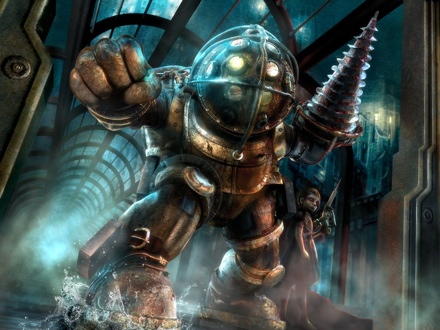 Of the various loves in my life, one of the most abiding and constant has been video games. I haven't really blogged about video games at all. I never blogged about how much I love the Fallout series or how many hundred yen coins I spent in Japanese game centers. It's a topic that I've avoided, semi-intentionally.
However, I'm compelled to gush about how much I love BioShock. Not that the series needs it- BioShock is a tremendously successful franchise and it doesn't really need any more geeky adoration being spewed in its general direction. I can't stop myself, though. I need to shout like a screeching fanboy. There is a big overriding reason why I love it so much, something utterly apart from the great gameplay, wonderful design, excellent writing, and creepy atmosphere. Those things are great. However, there is another, very simple reason why I love this particular FPS so much:
BioShock is a game about shooting Ayn Rand in the Face.
The original game is a refutation of Atlas Shrugged in video game form. Somewhat more importantly, though, it is also a satire of video games in general, and at the same time makes a point that could only be made in video game form. That's what I really want to talk about. BioShock wouldn't be what it is if it were a movie, book, TV show, or any other kind of media. It's great because it makes the most of what it is.
Okay, spoilers ahead, everyone! For both games.
The First BioShock game is all about the hubris and failure of Andrew Ryan, a stand-in for Ayn Rand. Ryan built himself an undersea utopia that failed miserably. His vision was based on unabated individualism and constant nattering about "parasites" who spoil life for the shiny paragons of industry and brilliance.
BioShock is also all about the protagonist (you) gradually finding out about who the hell you are. At the beginning of the game, we see the main character in a plane that crashes into the Atlantic, and immediately assume that he's just an ordinary, hapless survivor who happened upon the underwater city of Rapture. Much later, we learn that he actually hijacked the plan and caused the crash.
What's more, we find out that the character has been manipulated the whole time. He has been under mental compulsion for the vast majority of the game, but you wouldn't know it from the gameplay. At no time is control really wrested from you- you play BioShock as you would any other linear game. However, you don't have any control about what the character will do. You do what you do because NPCs tell you to do stuff, and because you are led by the nose in a linear fashion.
It's amazing because you are able to embody someone you know nothing about. You can't see the protagonist's face, can't hear him speak, and know nothing, really about who he is. Yet you embody him and identify with him anyhow. Eventually you find out that what you thought was a bland, voiceless video game protagonist was actually a genetically manipulated zombie who had very little choice about his actions. The surprise of the big reveal could not have worked in any other medium.
BioShock 2's ending is somewhat less satisfactory- you find out that your daughter has been watching you the whole time, and that your actions have determined her character. I chose to be a nice, shiny paragon of goodness who helps people, so she, in turn, turned out to be an idealistic, sunny person. Apparently if you decide that you like killing and selfishness, your daughter turns out to be a kind of a bitch at the end.
I suppose that this is a pretty good approximation of parenting- you're actually raising your kids all of the time, not just when you think they're watching you. You know, like this:
Anyway, BioShock (both of them) are great video games because they take full advantage of the fact that gamers embody the protagonists, and don't really think that much about whom they are embodying. At the end of the first one you get hit with "Guess what! You're a juiced-up zombie bitch with no free will! How do you like that? Now, would you kindly kill Ayn Rand with a golf club?" The big surprise at the end of the second comes down to "I learned it from watching you!" wherein you discover that parents who mercilessly harvest Little Sisters have kids who mercilessly harvest Little Sisters.
In books, movies, television shows, comic books, or any other medium, the observer cannot slip into the protagonist's shoes, cannot embody them. In video games, though, that can happen. BioShock allows you to embody characters that are not who you thought they were, or doing things that you did not think they were doing.
Gaming can put you in disorienting the position of not only observing actions, but doing them and not understanding them, with great emotional effect. It is something I would like to see more of. Rather than just games where players pursue goals for pasted-on reasons, I would like to see games that take advantage of this disorientation that comes from character embodiment. The only other video game that I can think of that has effected me as much as either of the BioShock games has been Silent Hill 2, wherein the protagonist wades his way through the shadowy world of love and uncertainty that is husbandhood. (Given that I was living with my girlfriend while I played it, it kind of hit a nerve.) In all cases, my emotional reaction came from the fact that I did not just watch the drama happening, but had to deliberately make it occur, had to move it forward via the character. I empathized more strongly, and felt more real fear, because of that. I do think that video games can be a powerful medium, and am happy to see that they have become more complex and emotionally charged over the years.
Also, more things should be about giving the finger to Ayn Rand. Just putting that out there.
Monday, February 15, 2010
Why I Think That Lady Gaga is Pretty Great Even Though (In Fact, Because) I Don't Want to Have Sex With Her.
 There are lots of celebrities whom I would like to have sex with. Lady Gaga is not one of them.
"Joe, you red-blooded bucket of unabated virility and leonine manliness! Why on earth not? Aren't you utterly entranced by the current Empress of Popular Music?"
Well, Hypothetical Reader, yes. Yes I am. I find Her Gaga-ness as fascinating and entertaining as any other consumer of popular culture. However, unlike so many other nubile young famous people, I don't really want to fuck her. When you really think about it, that's kind of neat.
And also, really, really fucking weird.
I mean it! Really weird. Utterly strange. Most of celebrity, fame, and general media-ness has to do with the parading about of pretty young things, both male and female, whom the general populace can fantasize about whilst touching themselves at night. If you disagree with me, then I would like to politely refer you to to Jersey Shore, a massively popular television show that seems to be mostly about breasts and hair of titanic proportions, and men who possess no shortage of hair gel but not a single shirt.
I suppose what I'm trying to say, is that if you don't think that popular culture is about fantasy sex, then you are a delusional stupid person who has a bowl of sodden guacamole instead of a brain.
So, yeah. Anyway, here's how it usually works in the music world: You've got your standard rock-star person up there on stage. Let's say it's David Bowie, someone who's also known for being sort of weird and shiny. There are lots of women in the audience. These women are watching and enjoying the music, but also, on a certain level, they probably want to fuck the Thin White Duke. Sure, it might be in just a little corner of their mind, but they think to themselves "I would totally do his glitter-covered ass." Many of them would settle for having their male consorts be a bit more Bowie-like, and proceed to pursue men who wear impossibly tight pants.
You've also got men in the audience, men filled with a sense of identification who want to be David Bowie. They don't want to fuck him, but they want to be him while he's fucking someone else. They put themselves in his role, and they get off on it. This is why James Bond is popular.
Meanwhile, you've also got gay and bisexual dudes who want to be and fuck David Bowie simultaneously, and they are probably having the best time of all, eventually breaking out into a cocaine-fueled dude orgy that fills the other people in the concert with a mixture of arousal, envy, and fear.
Where were we? Oh yes. Sexy fame. That's how it usually works.
Lady Gaga does not seem to do this.
"Joe, you massively erudite cogitator! How could you say that? Didn't you notice how she often dresses in a provocative manner?"
Yes, Hypothetical Reader. Yes I did.
Lady Gaga objectifies herself. I do not mean that she objectifies herself in the sense that the word is normally used, but rather she portrays herself as an object, specifically something manufactured. In her videos she's often made to look artificial or damaged in some way, covered in armor, plastic, bandages, or exotic clothing. She does bare a lot of skin, yes, but she comes off more like something that has been engineered to be a simulacrum of sexuality. There is a sort of perfunctory and robotic way of her movements, or rather, how her videos are shot and edited to portray her movements. She and her backup dancers move like they are filled with pnuematic cams and shafts, and there is a an unnatural, puppet-like lurching to her.
She does not flirt with the camera. There is very little in the way of knowing winks or direct interaction with the audience. Instead we are given a kabuki-like tableau of massively elaborate costumes and enigmatic visuals. Faked sex in popular entertainment is often pitiable, and Gaga, rather mercifully, does not attempt it. Instead, she revels in her bizarre nature persona.
I like this. After seeing lots of interchangeable starlets look directly into the camera and act like they are singing just for you, Gaga's detached and cold videos are immensely refreshing. She does not attempt to be authentic when she is not. She does not pretend she is not artificial when she is. She is completely honest about how fake she is which kind of makes her like Andy Warhol, except that she's entertaining.
It also makes her more honest than, well, most other pop stars. Lady Gaga proudly proclaims that she is a product of an advanced industrial society, a singing, dancing super-robot. And she is a glorious super-robot, a fantastically well-engineered one.
Which brings me back to my original point: I don't want to fuck a robot. Sure, I used to live in Japan, but I never really got into that scene.
I respect a well-engineered and transparently fake thing. I like machines, spectacle, and moving shiny things. Moving shiny things like Lady Gaga. Her whole schtick is well-executed artificiality, and that beats fake authenticity any day. It also acts as a refreshing counter the cloying and ultimately pitiable attempts at sexiness that are so often trotted out for our collective "entertainment."
So, no. Gaga the android, the plastic-and-brass dance robot, the techno-puppet, does not arouse. She does something better- she entertains.
Friday, February 12, 2010
ATTENTION POP CULTURE: Hades Was Not That Bad a Dude!
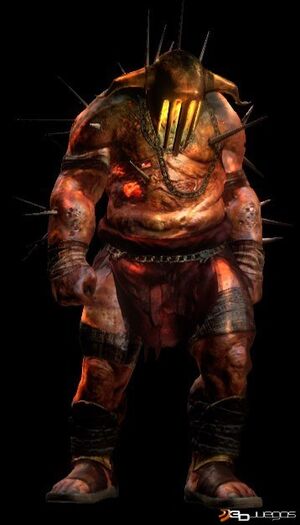
 There seems to be a not-very-promising-looking kids movie coming out today all about the Greek gods. I have no plans on seeing it, but I'd like to use this as an excuse to talk about something that has bugged me a lot: Pop culture's persistently negative portrayal of Hades. You know what I'm talking about- he's usually portrayed as some kind of Greek version of Satan, or like something off a death metal album cover. Apparently in the shitty-looking new movie coming out today, he's one of the main bad guys. And remember the Disney movie with Hades as the bad guy? Or how he looks like some inhuman S&M fantasy in the God of War games? It's everywhere.
Unfortunately, this popular depiction of one of the major Olypians is utter bullshit. While the ancient Greeks were afraid of the lord of the Underworld and found him to be something of a hardass, he was not the "bad" member of the pantheon.
Hades was the more or less passive ruler of the next world. If he were a D&D character, he would have been Lawful Neutral king who managed his domain the same way that Zeus ruled the sky and Poseidon the sea. (Solid earth was open to all of them.)
The Greek underworld itself was also pretty varied, it wasn't just a hell-like place where everyone got zapped with flames or tormented in a Dante-like fashion. For the most part, it was gloomy and boring, though the Elysium and Tartarus were offshoots of the underworld, where souls were either rewarded or punished, respectively.
While Hades was considered a fairly morbid and fearsome guy, people were afraid of him and his domain in the same way that people have always been afraid of the irreversible nature of death. A realm of death and eternity that no one could ever leave is kind of scary no matter how you slice it, but Hades was nothing like this:

Or this:
If anything, he was one of the more just Olympians. Yes, there was that nasty business with the rape of Persephone, but for the most part he was a pretty passive and predictable administrator. You know who was a pretty nasty member of the Greek pantheon? Well, almost all of them. Zeus, for instance, was a colossal dick, what with all the womanizing and the petty punishments he kept dishing out. Ares was a bloodthirsty maniac. Even Athena, one of the more likable deities, got all bitchy envious and turned Arachne into a spider. They were a petty, nasty belligerent bunch, which is why they're such great characters and we continue to tell stories about them to this day.
But, for gods' sakes, please stop using poor Hades as the stock bad guy. Cut the poor dude a break. If anything, Ares was the nastiest, what with all of the bloodlust and destruction.
BONUS MYTHOLGY RANT!: You know the sequel to The Mummy? Remember how The Rock makes a deal with Anubis and gets super-powerful? Remember how Anubis was portrayed as basically the Egytian version of Satan? Also wrong! Anubis was the god of morticians, and basically in charge disposing of corpses in a sanitary fashion. Portraying his as the malevolent figure in the Egyptian pantheon makes about as much sense as depicting St. Peter as the central villain of Catholicism. IT MADE NO SENSE! Especially since Egyptian mythology had Set and Apophis, two perfectly interesting malevolent baddies, available. Why did they pick on poor Anubis?
Subscribe to:
Posts (Atom)