Sunday, July 25, 2010

In Which I Probably Read Too Much Into Dirty Harry

I recently watched Dirty Harry for the first time, which had since then been something of a hole in my pop-culture education. I enjoyed the movie, but found its politics to be somewhat objectionable.

To briefly sum up the film, Harry Callahan pursues and catches the Scorpio killer, a serial murderer who uses a sniper rifle, through San Francisco. Scorpio is let loose after his release, though, because the district attorney say that Harry didn't inform the suspect of his rights, that he violated multiple sections of the Constitution, and that all of the evidence that Harry obtained was done so illegally.

The scene in which Harry is informed by the district attorney that there is no way that the authorities can bring a case is preposterous. If anything, a district attorney passing up the chance to put away a serial killer seems highly improbable. The chance to lock away a high-profile sicko is the career-making move that most DAs probably dream of.

However, the prospect of realistically portraying the civilian authorities (along with the DA, the police chief and the mayor are portrayed as similarly toothless) is not Dirty Harry's project. The film goes out of its way to portray such authorities as weak so that Harry, by comparison, may appear strong.

Dirty Harry posits that the warrior caste of a society may second-guess the civilian authorities. Not just may, but should. Harry's decisions are portrayed as wiser, braver, and more socially responsible than those of his police chief, the district attorney, or the mayor.

A democratic, civilized society means that the state retains a monopoly on force. Force is controlled, regulated, and not used lightly. Private citizens may not initiate force- they may only use it in self-defense. Indeed, the state may not display aggression, either- it may only use it in a situation where the larger ends of society are served by the judicious application of violence.

Those who apply violence for desirable social ends do so at the pleasure of civilization at large. The police and soldiers who may engage in violence do so in a context where they are ruled by civilization. It is most decidedly not the reverse. The warriors do not rule in a democratic society. (Hence the hooplah some years ago about W. wearing an Air Force jumpsuit. Presidents, even if they have served in the military, traditionally always wear civilian clothes.)

Dirty Harry posits that the mechanisms of democracy are fundamentally broken, that the safeguards of law and order, the rights embedded in the Constitution, are deterrents to justice. In Dirty Harry, the implication is that if San Francisco really wanted to catch the Scorpio killer, if they were serious, then they would not go to the mayor, the police chief, or the DA. If they were serious, they would go to Harry Callahan and allow the warrior caste to call the shots over the civilians, not the other way around.

The stance implied by the film is a deplorable and socially irresponsible position, basically stating that borderline-sociopathic individuals such as Harry Callahan are necessary for civilization's survival. The whole thesis of the movie reminded me of another famous speech, wherein Jack Nicholson's Co. Jessup rationalizes his existence in A Few Good Men.


The scene above, though, is more nuanced because Jessup is explaining himself to other members of the military. A Few Good Men is essentially about members of the armed forces who conduct themselves as normal participants in a democracy rooting out and investigating those (such as Jessup) who behave as if they belong to an exceptional warrior caste a la Harry Callahan.

The polar opposite of Nicholson's speech (and ideological sibling to Dirty Harry) is Team America: World Police. I've always found the final (NSFW) speech to be something like the opposite of A Few Good Men, and in it Trey Parker and Matt Stone seem to articulating something akin Dirty Harry's thesis- that society needs a certain population of nasty, violent people in order to survive.


Though they admit that pussies are necessary, too. How big of them.

Make no mistake, I am not a pacifist. Not by any means. I don't believe that we should dismantle the Pentagon or anything like that, and I find people who are reflexively anti-police to be kind of strange. Every contact I've had with people who've been members of the armed forces or law enforcement has led me to believe that those who are responsible for public safety are more or less normal people. I worked for the Department of Public Safety at the University of Oregon for two years, and none of the police officers I met (a few of which were former military) seemed nearly weirdly barbarous as Harry Callahan. My grandfather was in the U.S. Army, and while he had seen and participated in WWII's horrors, he certainly wasn't a monster.

Granted, the Dirty Harry is a bit self-conscious about how monstrous the protagonist is- the word "dirty" is right there in the title, after all- and I'd be lying if I said that I didn't delight in seeing Clint Eastwood blow dudes away while glaring that steely glare of his. But, Dirty Harry tries to turn the pathologies of the main character into virtues; virtues that civilization supposedly needs in order to endure. We do need warriors, certainly. We need cops and soldiers and marines and fighter pilots. That is true. But we do not need monsters. We do not need Col. Jessup or Team America, and we certainly don't need Harry Callahan to survive.

Wednesday, July 21, 2010

Awesome Thing: Tea

Tea is beautiful. It is, without a doubt, my single favorite beverage. Other than water, it is the only thing that I drink every single day. It is more flavorful and stimulating than any sort of juice, not as blunt or intense as coffee, and far more peaceable than anything alcoholic. As much as I love coffee and beer, Portlander that I am, tea is foremost in my affections. The first thing I do in the kitchen is put on the kettle and I inevitably begin my day with at least one cup of the stuff. If I don't have to go to work I'll generally down a few cups throughout the day.

It's the ideal beverage for writing or reading. At the keyboard, I'm usually typing between sips, and while reading a book on my porch I often have a mug close by. I associate tea with literary endeavors, with the inspired creation of words or the calm, solitary appreciation of them.

The words "tea party" have now become utterly synonymous with bombast and nonsense. I find this not only disconcerting, as a tea lover, but also deeply weird. Tea, the most peaceful of beverages, the most contemplative and calm, the kindest and most thoughtful of stimulants, is now a signifier of yowling, yelling yahoos.

Tea does not deserve this. More to the point, tea does not fit this. The contemplative nature of the beverage clashes horribly with right-wing ideologues, with upraised fists and brandished signs. Tea is a learned beverage, the least barbaric and most civilized of all drinkables.

I believe it's reputation will persevere. Tea, after all, has been with us for millennia, and the maniacs now screaming in its name have existed for less than thousandth of the age of the beverage. Tea will, once again, be known as something calm, rational, civilized, and logical. Until then, my favorite drinkable will take its lumps, not of sugar, but of irrational defamation.

Wednesday, July 14, 2010

Live, Real Star Trek: "A Group of People Dating Back to the 1990s..."

This is mostly about Star Trek, yes (as you can surmise from the accompanying illustration). But, bear with me as I digress for a moment about Star Wars.

Long ago, in the before time, I remember an era when Star Wars was still cool. In that time (the late 1990s) the movies were re-released in theaters, albeit with modernized special effects and additional footage. I remember sitting in a theater as an exuberant teenage, excited to see it all on the big screen. The audience whooped and applauded, laughed and hollered with raucous energy as the movie went on. Darth Vader was greeted with hoots and people shouting "yeah!" and a wave of applause went up when the Death Star exploded.

One of the biggest reactions from the audience, though, was towards the beginning. I remember it very clearly. Luke, kvetching to his uncle, says that he wants to go to Toshi Station with his friends and "pick up some power converters."

The audience roared with laughter, applause, and general appreciation. It's probably one of the cheesiest lines in Star Wars, and brings to mind all manner of B-movie derision. Luke's line sounds precisely what some hack writer would think up to tell the audience "Hey, guys! We're in a futuristic universe here!" and given what we know about George Lucas, that's probably exactly what it was.

Nevertheless, the audience cheered with very real affection. The transparent artifice of the line did not stop them from loving it. If anything, it was the reason that they roared with approval.

I was reminded of that moment last weekend when I saw Trek in the Park, an event wherein a Portland theater troupe performs an episode of the original Star Trek live. I went to it last year and enjoyed myself, so there was no way I was going to miss it this time around.

Like last year, it was loads of fun. The particular episode they performed was Space Seed, better known as "the one with Khan in it." The thing about the performance that reminded me of Luke's legendarily groan-worthy line, was that Khan is from the 1990s. When Star Trek was aired in the sixties, I suppose that the nineties were still distant and future-y enough to write science fiction stories about. According to the original Star Trek timeline, Earth apparently got into an enormous eugenics war in the late twentieth century, bred a bunch of supermen, developed interstellar travel (but without FTL) and generally devolved into chaos. Space Seed contains several references to this, and to "the twentieth century" in general.

A few choice lines:

"Much older. DY-100 class, to be exact. Captain, the last such vessel was built centuries ago, back in the 1990s."

"Seventy two alive. A group of people dating back to the 1990s. A discovery of some importance, Mister Spock. There are a great many unanswered questions about those years."

"With simple nuclear-powered engines, star travel was considered impractical at that time."

"Earth was on the verge of a dark ages. Whole populations were being bombed out of existence."

"[Khan's] age would be correct. In 1993, a group of these young supermen did seize power simultaneously in over forty nations."

"From 1992 through 1996, [Khan was] absolute ruler of more than a quarter of your world. From Asia through the Middle East."

...and so on.

The performers, though, made absolutely no attempt to cover up how unashamedly retro this all was. If anything they reveled in it. Much like that crowd at the screening of Star Wars who had such a great reaction to Luke's ultra-cheesy line, the crowd lapped up with verve and amusement any reference to the nineties, and anything else hokey or otherwise dated. On top of that, a full complement of electronic music and woo-woo sound effects accompanied the performance. All through the production music that would have been massively futuristic fifty years ago hummed away.

What was weird is that the hokey stuff really made it all better. The concession to genre, anachronism, and borderline kitsch seemed to alchemically combine into something that was, actually, very awesome. Had they attempted to modernize the production or play it straight, it wouldn't have been nearly as enjoyable. Nor do I think (and this is what I find sort of weird) I wouldn't have been nearly as emotionally invested in what was going on.

I am fascinated by an audience's ability to laugh at something for being silly, hokey, and sort of dumb; but at the same time be utterly charmed and on board with it. Nearly every single person there was utterly into how, well, Star Trek-y it all was, how a piece of sixties SF was walking and talking right in front of us. We were rooting for it because it was anachronistic, full of genre conventions, and of its. Not despite those things. We can laugh at the absurdity of another time without mocking it, regard artifacts as absurd and all the while wholeheartedly embrace them.

Wednesday, July 7, 2010

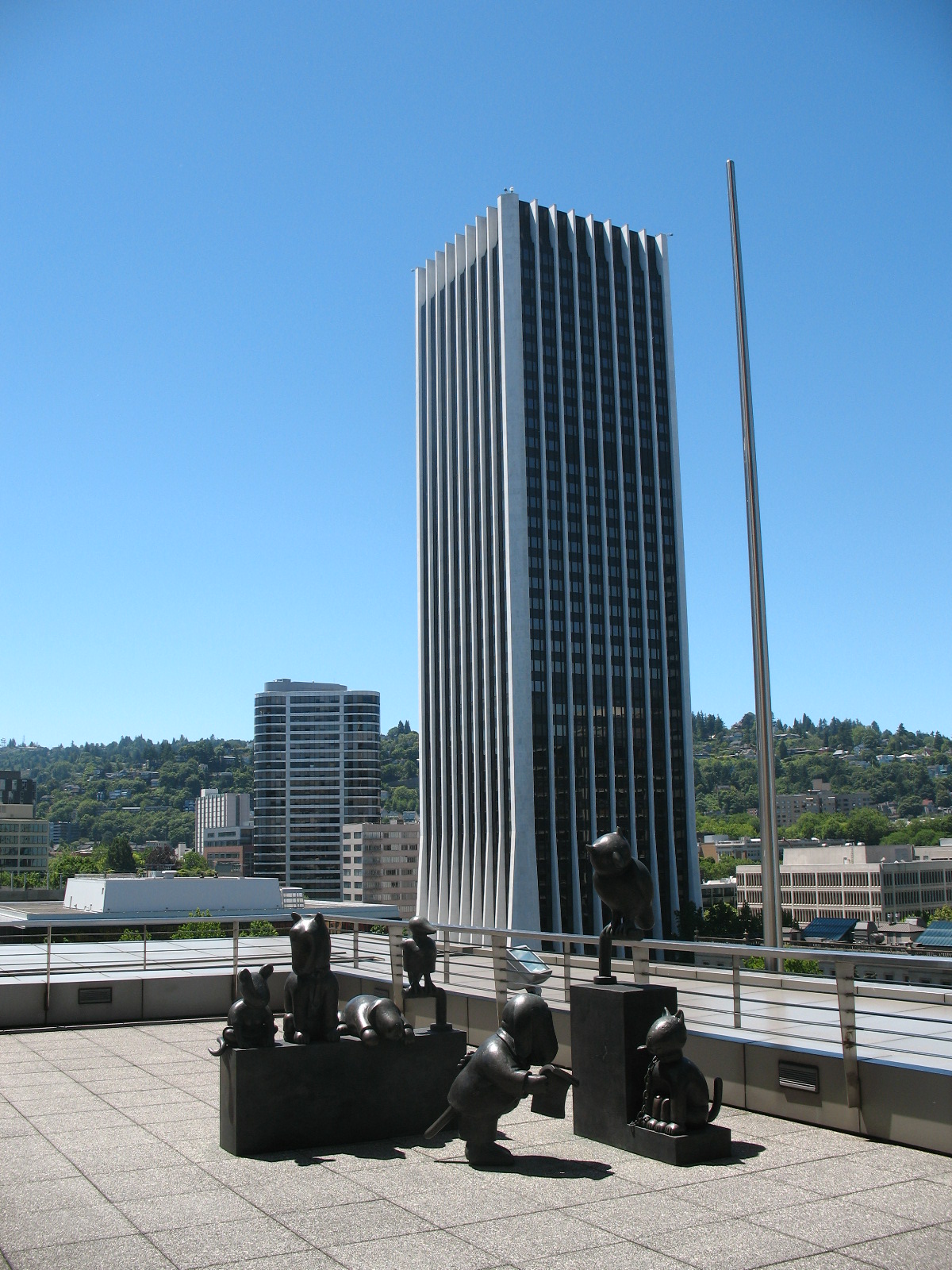
Awesome Thing: The Mark O. Hatfield U.S. Courthouse Sculpture Garden

If you live in Portland, you've probably seen the looming ultramodern tower that is the Mark O. Hatfield U.S. Courthouse (MOHUSC). Since it was built in 1997 it's a building that I've consistently admired, a fact that I find continually surprising for two reasons. For one, many of the things that I thought were cool in the '90s (black turtlenecks, Mortal Kombat, putting "2000" on anything) are, in retrospect, sort of silly. Architecture in particular seems to wear its age badly, though. The things that probably looked futuristic and cutting-edge throughout the twentieth century usually look hopelessly anachronistic now. Postmodern buildings such as the Portland Building were edgy once, but they now they're the structural equivalent of a George Michael album; dead-end fashions that everyone involved wants covered up.

Paradoxically, the recently contemporary often seems even more aged than the truly old. The boxy Oregon State Capitol exudes the 1930s, but the much older Capitol Building in Washington, D.C. seems timeless and therefore more contemporary. (Total aside, but this reminds me of the probably apocryphal story of an English professor who, in the 1950s, decided to translate Hamlet into beatnik so that young people could relate to it better. The resulting text ended up being utterly impenetrable ten years later, but the original Shakespeare could still be grokked without much difficulty.)

The point is, that if you're going to make something and have it look edgy and contemporary and neato, you run the very high risk of being passe in a few years. When making big, permanent things like buildings, this is something you want to avoid. People are going to be staring at these buildings for quite some time, and you really want these buildings to seem contemporary in some form or fashion long after their styles were "cool."

So far, the MOHUSC is holding up. When I walked through its lobby the other day, it impressed me as much as it did thirteen years ago. It seems utterly futuristic in a classy, subdued kind of way. The interior is filled with stark, quiet lines and blocky structures that are somehow also elegant. It's big and stark and empty, but also impressive, precisely the kind of thing that made the young me want to be a lawyer.


And it has a sculpture garden on the ninth floor.

Since the MOHUSC is a public building, anyone who wants to can walk right in, go up the elevator, and hang out in the sculpture garden. Granted, the sculptures themselves are sort of silly- a collection of animals and anthropomorphic computers that are collectively titled "Law of Nature" -but the space is highly neat. It is secluded, affords a great view of the city, and is open to the public.


It's a nice space in what could otherwise have been an utterly utilitarian government building. I was alone for the entire time I was up there, which I didn't expect, but was refreshing. Again, the statues aren't great art- they're silly little animals dressed up as lawyers, but I like it that tucked away in a large, ultramodern building is a little bit of flourish, and anyone who likes may admire the skyline, the surrounding buildings, and the greenery below.


Monday, June 28, 2010

Late Evening of the Living Dead Bicyclists

Last night I found myself wearing a Jesus costume and leading a coterie of bicyclists dressed as zombies around NE Portland. Our fair city's (now annual) zombie bike ride was upon us, and for a number of reasons I suddenly found myself leading the thing. Needing to stand out from the biking horde of slavering cyclists, I decided to comport myself as the most famous zombie ever, a dude who shambled out of his grave three days after a rather nasty torture/execution session.

We met up in a park, and my friend L was good enough to show up with a batch of corn syrup, red food dye, and flour. As I'd only recently had the responsibility of the ride foisted on me, and didn't have any fake blood, L was a lifesaver (or rather, unlifersaver) for bringing the hemoglobin. A few pictures-

Here's L, devouring her somewhat chagrined boyfriend:


This gentleman did the "military guy gets zombified" thing. He had very creepy teeth.


"BEEEEERR!"


Slathered in L's fake blood, this girl looked a bit more like Carrie than a zombie, but she certainly pulled it off. She should watch out, though, because the girl behind her seems to be contemplating Carrie-centric mastication.


Our attempt at a zombie last supper:


You can't really see it in the picture, but these girls are covered in glitter blood. We decided they were Twilight zombies.


Zombie dance! We stopped at three places, and rocked out to Thriller at two of them. The night closed with zombie karaoke at a tiki bar where numerous zombies (as in the drink) were consumed. I decided that the best thing for Zombie Jesus to sing would be Highway to Hell.


As people went home, more than a few of them said "Thank you, Jesus!" I kind of love my lifestyle.

Tuesday, June 22, 2010

Night of the Living Naked Bicyclists

Yes, that's me. In that picture I am wearing the following items:

-Socks

-Shoes

-A bicycle helmet

-A messenger bag

-Paint

...And that's it. Saturday was the World Naked Bike Ride here in Portland, and I was not going to miss it. Last year, I learned of the event too late and wasn't able to participate because I was playing Dungeons and Dragons. Yes, really. While thousands of other Portlanders were getting naked in the streets last year, I was playing D&D. (Though, it was a really fun D&D session...)

The Oregon constitution goes a bit further than the federal one with regards to protected speech. Because the World Naked Bike Ride is technically political speech (we were ostensibly there protesting oil dependence), the ensuing bike-mounted parade of butts, boobs, and saddle-mounted wangs were 100% legal. The police were out in force... corking traffic for us. Several of the cops waved, and one particularly enthusiastic officer of the law was throwing metal horns to the various naked cyclists.

This was the second time in my life that I've been naked on a bike, and just like when I got naked for a flaming lips video, it was pretty much entirely nonsexual. I'm not about to turn into some kind of ideological nudist, but damn it was fun. Lots of fun. Overturning social mores almost always is.

A steady crowd of onlookers had massed on the street, often with their arms out, high-fiving the participants. The naked participants, in turn, often shouted things such as "Take off your pants!" to the crowd. Amazingly, some of them did. There were more than a few naked onlookers, most notably a very well-muscled gentleman sitting naked astride a motorcycle and giving everyone a thumbs up. If there ever was a potential cover for a gay metal album, he was it.

One of the bums I recognized from Old Town also decided to get naked, and there, on the side of the road, he was wearing nothing but dirt whilst bouncing up and down excitedly. I could have gone the rest of my life without seeing filthy bouncing hobo wang, but there it was. Also in Old Town a rather obnoxious frat-boyish sort of guy screamed "Where the titties at?" I thought this was sort of a curious thing to say given that titties were everywhere.

Like I said, overturning social mores is nearly always fun. The feeling of everyone getting together and saying "Hey, guys! Let's temporarily operate using alternative social constructions!" is precisely the kind of thing that can make lots of people say "Woo!" It's a refreshing reminder that things are mutable.

It was highly neat. If I'm in Portland next year, I'm definitely getting naked again.

The Idea of Los Angeles, Part Two, Wherein a City is Redeemed in My Eyes

Hollywood is awful.

Up until I set foot on Hollywood Boulevard, I'd been enjoying my time in L.A. I'd had a fine time at the beautiful, art-filled Getty, and the grandly sleazy Venice Beach. The palm trees, gimmicky as they were, gave the place a recognizable sort of local character, as did the Spanish-inspired hacienda architecture. Other than lacking public transport, L.A. didn't seem that bad.

Until I got to Hollywood, which was, easily, the single most disappointing tourist experience of my entire life.

Now, I'm all for the whole "be a traveler, not a tourist" type of sojourning. Walking down an unfamiliar street or sitting in an unfamiliar local bar or restaurant can be quite rewarding. One of the things that delighted me about L.A. was just being in a different sort of environment, taking in the buildings, people, and climate. Appreciating the change in latitudes, etc.

But, every so often, I like to have me a good-old-fashioned tourist experience. There is nothing wrong with going to a well-recognized landmark and saying "Woo! There's the Golden Gate Bridge/Taj Mahal/Statue of Liberty/Big Ben/Great Wall! Wow! I'm actually looking at it right now!"

Mind you, I was warned. "Hollywood is kind of crappy," said Seph, as we drove there. I assumed as much. I thought that it would be a row of shops and restaurants, and that would be about it. I had low, low expectations, and I was okay with that. Mainly, I was happy to be hanging out with a good friend in a new city.

Hollywood, however, did not meet even my low expectations. The place is an utter shithole. A depressing and despondent stretch of concrete. It is exactly the kind of place where beggars ask for weed instead of change. The shops along the way ply movie memorabilia and stripper boots, all the while bedecked with promotional posters and faded cardboard cutouts of Marilyn Monroe, Hollywood's suicidal bombshell of a mascot.

The stars on the street are bland and undifferentiated. There is very little separating Jack Palance from, say Larry King. They are cracked and largely uninteresting, and resemble inexpensive headstones more than anything else. Ostensibly I was walking up and down a monument to art and glamor, but I felt nothing. The stars were generic and perfunctory. Even finding one dedicated to one of my heroes didn't move me particularly much.


Yup, that's Gene Roddenberry's star, and that's my foot on it. I was genuinely attempting to enjoy myself and find something to like about Hollywood, and hoped that Star Trek would fit the bill. I love Star Trek. To me, Star Trek is warm, wonderful, safe, cuddly, and comforting. It is like chicken soup combined with oatmeal, but not in a gross way. Star Trek is like an old friend who knows exactly what to say can totally make you feel better. If I ever have a kitten that gets caught in a blender, I will seek solace in Star Trek. If I ever am enduring a bad acid trip and start believing that the curtains are trying to eat my lungs, I'll try to calm down with Star Trek. If I ever lose both my earlobes in a freak Cuisinart accident, I'll try to cheer myself up with Star Trek.

Star Trek, however, didn't really make Hollywood that much better.

Here's another Trek-related picture. Again, this is me attempting to have fun.


Unfortunately, despite the pistol-pointing and my jaunty smile, I am not experiencing very much of what can be called "enjoyment." I'm making a good go of it, though.

That picture, by the way, is right in front of Grauman's Chinese Theater. Now, it is a very cool looking building. The place is wonderfully distinctive, and I liked that a lot. Something that I think is sort of funny about the theater, though, is that it's so obviously reminiscent of yellow-peril Orientalism. Now, I'm not going to go all Edward Said on you, but one could definitely imagine Ming the Merciless or Fu Man Chu walking out of the place (not that that wouldn't be awesome, mind you). I wasn't in China very long, but the exterior didn't really match many of the historical buildings I saw there. It seems much more of a "woo-woo exotic East" sort of building, rather than anything built by, say, actual Chinese people.

The building is still a working theater, which I like. Landmarks are especially interesting when they are still actually used by their local communities. The front of the theater, though, is choked by tourists. On several different occasions, a uniformed staff member asked us if we wanted a tour, and we declined. People were constantly snapping pictures of the handprints and footprints in the cement, and the place really was spoiled by its obvious identity as a tourist trap. A nearby tour was a Chinese chapter of Amway who probably came to the States for a convention pertaining to their grand pyramid scheme. People wearing shorts and khakis milled about, and I was sort of embarrassed for the setting. I really, really don't want to sound like a cliched, snotty, Kerouac-reading backpacker here, but the crowd of tourists really did make things suck.

At the same time, though, I empathized with the people there. I wondered how many of them were having a supremely shitty time of it all, kind of like I was. How many families from Iowa rolled into Hollywood expecting... something? Something significant and at least partially enthusiastic. Something other than a street names less interesting than the cheapest of headstones. How many of these Iowan families went back to their rooms at their mid-ranged hotels and wondered if they'd done it wrong? How many of them thought, "I didn't see what's so great about Hollywood. Maybe I went on the wrong day? Maybe I didn't go to the good part?"

Hollywood has a reputation, a reputation that draws those families from Iowa who show up with their shorts, khakis, and expectations. It does not back up that reputation. Hollywood half-heartedly goes through the motions, doing the bare minimum of what it takes to be a landmark or district of note. It lets each and every one of those Iowa families down, and, for that, Hollywood is a truly vile place.

Oh, yeah- the Hollywood sign. It's on a hill behind some smog.

In Seph's car, I became despondent. That's exactly the right word for it- despondent. At that point, I hadn't been able to completely articulate my disappointment with Hollywood, and my idea of Los Angeles was beginning to suffer. I thought, perhaps, that my horrid preconceptions of southern California had been right all along- that it was a massive but ultimately culturally insignificant region.

I thought for a moment that I really need to visit Austin. It's supposed to be pretty cool.

We made our way to a bar in downtown L.A. to meet a mutual friend. I was in a funk. About halfway through my first beer I said "I was astounded by how much, Hollywood sucked."

"Yeah," said our friend, "It's awful."

And there it was. I proceeded to go on a beer-fueled invective about why Hollywood was the most disappointing travel experience I'd ever had, and damn if it didn't feel good to hate on the place. After a few beers my spirits were up and I started milling about the bar, interviewing and photographing attractive strangers for an assignment.

We left the bar, and walked through downtown L.A. to an art walk. Stepping through the streets I realized that this was precisely what I'd been missing- walking through a city's downtown, strolling past stoplights, under skyscrapers, past people, and in an area where one feels that something is going on, there is some real authentic human activity vibrating all about you. Tokyo had this. Tokyo is my ideal of this, really. I could walk through that city all day (and did) and simply enjoy the crush of the crowds, the blare of the neon, and the ambient activity.

L.A. had a little of that, so far. I enjoyed Venice Beach because it was such a good strolling area and filled with weirdos, but Hollywood had erased that goodwill. Downtown L.A., though, began to redeem the city in my eyes. Or rather, L.A. finally started seeming like what I think of as a "city." (By the way, I know that it's kind of ludicrous to refer to the second-largest urban area in the U.S. as anything other than a "city," but I think you know what I mean.)

An art walk was in progress, and it dwarfed anything that Portland had to offer.

The streets were crowded with people of a particular demographic (mine) and various galleries were lit up and open. A band bedecked in sparkles and glitter played in one area, and I had no trouble collecting interviews and photos for my assignment. Eventually we found ourselves inside the Alexandria Hotel surrounded by people. In a ballroom a dorky-looking hipster guy was singing David Bowie karaoke. Art was strewn on the walls. Odd looking films were being projected. Very attractive people were milling about. Sexy architecture was being put to good use.

I said to Seph, "I am enjoying this."

"Welcome to my town, bitch!" He said this knowing that I'd just gotten it- that I'd just figured out that L.A. is worth it, after all. Our friend had to leave and eventually we found ourselves drinking in a swank-seeming basement club with vaguely steampunk-looking decor. Various people were dressed up in twenties garb, a pretty good jazz band had the stage, and several silent films were being projected on different walls.

"This is normal," he said to me, "there is always something going on."

I knew he was right, that with millions and millions of humans of course awesome things will emerge. Of course there will be things of cultural relevance and interest. I was immersed in an environment that I was enjoying a great deal.

I thought of my beloved Tokyo. Admittedly, there are plenty of lame parts of Tokyo- there are whole tracts of Chiba suburbs that are somewhat less than exciting. I'd much rather visitors judge it by taking in the performers at Yoyogi Park, geeking out in Akihabara, or getting plastered and going clubbing in Roppongi. There is still plenty of mundanity there, though.

If I lived in L.A., I'm sure that I would be able to find its equivalent of Yoyogi, or Akihabara, or Roppongi. I know that I'd be able to dig in and find the awesome bits, just as Seph had. Hollywood, though, the single most famous part of the city, actively makes you believe that that urban life just isn't there.

My idea of Los Angeles had indeed been revised upwards. I left with an overall positive impression. It is not just undifferentiated sprawl- there really are a few very nice things down there.

And if they ever get a mass transit system, it might actually be an alright place to live.